23/02/2026 0 Comments
A brief history of St Nicolas
A brief history of St Nicolas
# News
A brief history of St Nicolas
St Nicolas Church Cranleigh: A Short Statement
The year 1170 has been taken as the time when the Church was first built. There could well have been a small chapel on the site before this, but this was the year in which Norman estate owners were required by royal decree to provide places of worship for their tenants, and it is likely that Cranleigh was included in this wave of construction.
Cranleigh (then spelt Cranlegh or Cranley) was at that time just a random collection of farmhouses and farm buildings, with a population of little more than 200, mainly arranged on the north and south sides of areas of common land. The site of the Church was on the north side of this common land towards the east end of the village, but it is now set back because of the later encroachment of the common. It nevertheless provides a focus for this end of the village centre, and its tower is a significant feature, rising above the rooflines of surrounding buildings.
The earliest part of the existing structure is the two-bay arcade on either side of the Nave, with circular stone columns and semi-circular responds giving it a Norman appearance. When built, there would have been narrow aisles on either side of the arcade, not much more than 2.2m wide, separated from the Nave by circular stone columns and arches. In about 1200 side chapels were extended from either side of what was then the Chancel.
In the early 13th century these aisles were further enlarged to their present width, and new capitals and pointed arches were raised above the columns to accommodate the sloping aisle roofs; external buttresses were added to the aisles to take the thrust of the roofs. Later in the 14th century a new Chancel was built, with a pierced timber screen separating it from the nave. A screen and rood loft, with figures, in this position survived until the early part of the 19th century, before being sold off, but grooves in the piers to the Chancel arch indicate where it stood. There were also screens defining the side chapels. At some stage the centre aisle of the nave was sloped up to meet the former Chancel level, the difference in height being about 17 mm above the west end of the Nave.
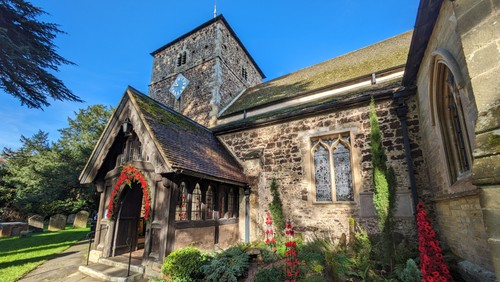
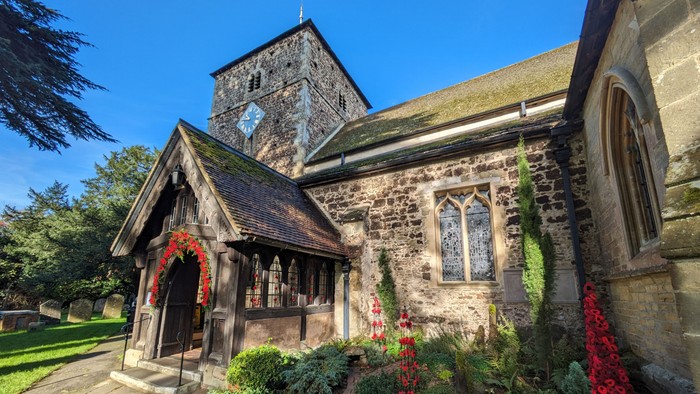
The tower at the west end of the Church is believed to date from the 14th century, although its massive construction, with stepped buttresses to the south-west and north-west corners, stone belfry staircase, and pyramidal roof, has led some writers to incline more towards an earlier date. The tower roof is in the shape of a pyramid called a ‘Sussex Head’, unusually with gablets at the peak. Open put-log holes remain in the walls of the tower. These were used to house the ends of scaffolding timbers when the walls were being erected, and have never been filled up. They may have been exposed when plaster was removed from the stonework during the 19th century. There are also some similar holes in the stonework of the north aisle. The orientation of the Church is 5° north of east, and the architectural style is mainly ‘Decorated,’ a term which covers the period from the late 13th to the second half of the 14th century.
The interior was considerably renovated in the middle of the 19th century, and the present pews date from that time. In 1864-67 the chapels on either side of the nave were extended to form transepts, which were finished externally in ashlar stonework. In 1944 the Church was badly damaged by blast from flying bomb that fell nearby, and the main lights of most of the stained glass windows were lost.
Most, if not all of the stone window frames have been rebuilt since they were first installed, but retaining their original form. In recent years the rebuilding of several corner stones of the walls and buttresses has also proved necessary.
Brian Bagot, Emeritus Church Historian

Comments